Custom Inflatable Paint Booths,
Engineered Around Your Process
A free design review from the team behind 90 ft pressure-vessel, 65 ft aircraft, yacht and 20-unit fleet booths. Tell us what you need to paint, where it will be painted, and what the site and compliance rules demand. We will tell you whether inflatable is the right process — and if it is, how it should be built.
1 business day acknowledgement · NDA available · No obligation
Proven on projects where the booth has to perform.
High-end custom, in our terms, means the booth is engineered around your process, your site and your compliance requirements — not around the lowest possible unit cost. We have proved that capability on demanding projects: a 90 ft modular pressure-vessel booth, a 65 ft aircraft booth, a marine yacht booth and 20 identical branded fleet booths.
If the deciding factor is the lowest cost per square foot, a mass-market importer is the better choice. We are built for projects where the booth has to perform.
This comparison describes two operating models. It is not a claim about any specific competitor.
An engineering verdict before a sales quote.
Free design is not free CAD and it is not an instant quote. It is an engineering feasibility review: can inflatable technology meet your requirement, and if so, how should it be built?
Included in the free review
- Feasibility verdict: suitable, conditionally suitable, or not suitable
- Concept layout: entry, work zone, airflow direction, equipment position
- Recommended dimensions based on object size, clearance and spray method
- Airflow direction and air-change guidance
- Material and filtration recommendation
- Indicative budget range and lead time
- Next-step scope and quote path
Not included in the free review
- Full CAD construction drawings
- Structural calculations
- PE-stamped or registered-engineer drawings
- Permit submissions and compliance filings
- Site survey and installation drawings
- Multiple major design revisions
These are a paid engineering package, scoped and quoted separately after the free review. We separate them so the free review stays honest and fast.
The decisions that make a booth work.
Material and colour come last. These are the decisions that decide whether the booth performs.
📐 Size & structure
Object envelope, clearance, door opening, modular spans and anchoring. From compact parts booths to 90 ft modular chambers.
🌀 Airflow & filtration
Cross-draft, downdraft or negative-pressure extraction; CFM, air changes, duct route and filter class specified against the coating process.
🧵 Material & construction
210D or 420D Oxford, PVC, airtight construction, flame-retardant options, reinforced floors and replaceable filter sections. Recommended, not guessed.
⚙️ Site & installation
Power, floor condition, transport access, blower placement, lighting, personnel doors, tool rooms and commissioning support.
Colour, branding and logo printing are available — but they are finish, not engineering. We specify them after the process is understood.
Projects that set the standard.
Each of these required a non-standard answer. Open a case to see the engineering decision behind it.
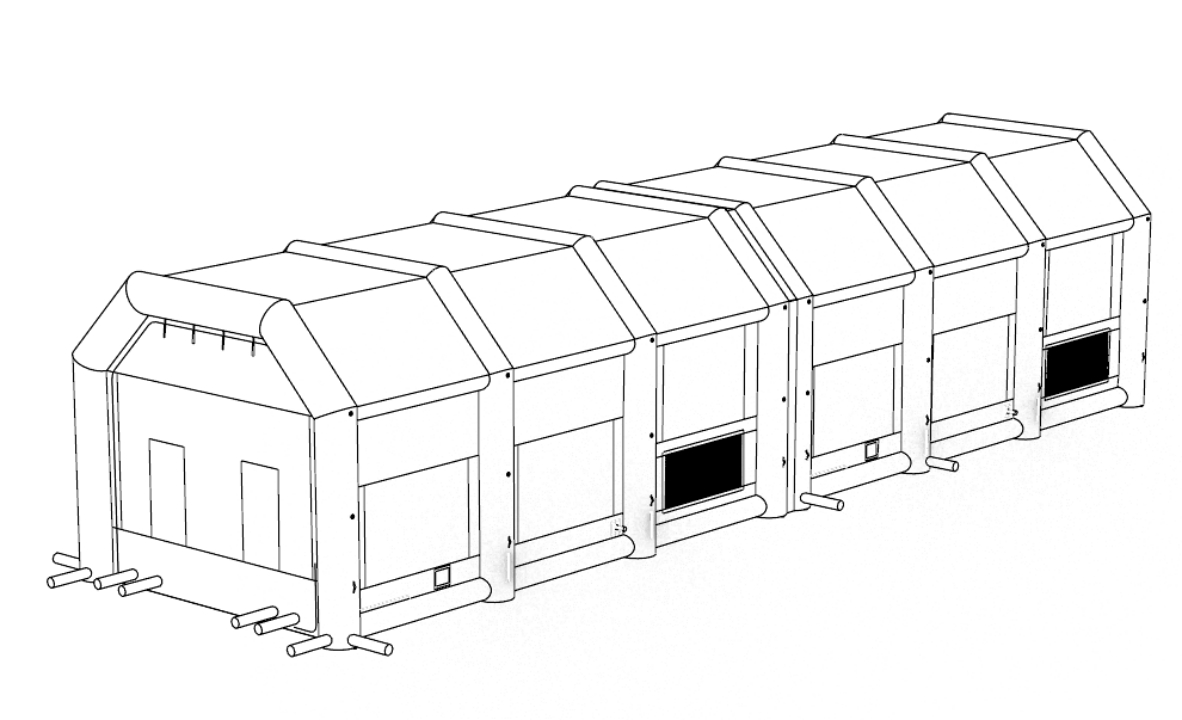
Two 45 ft chambers · removable Velcro floor for rail carts
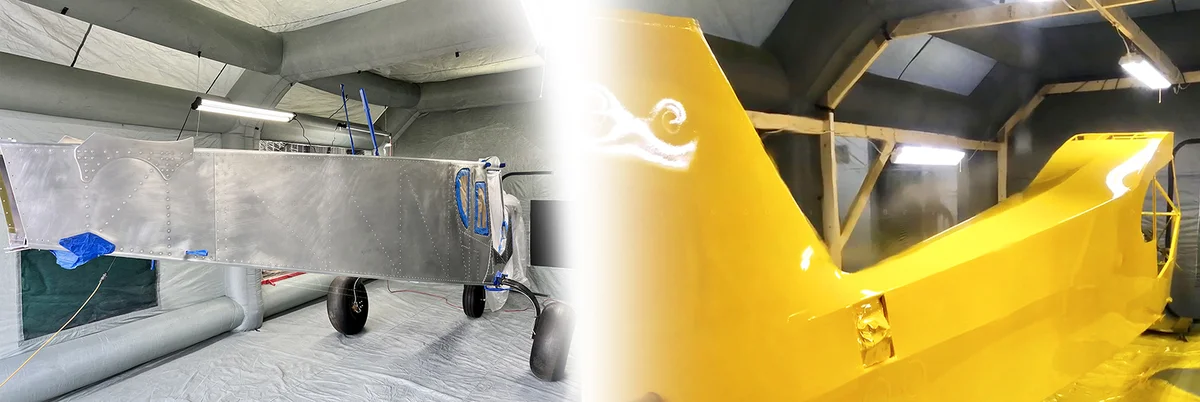
Custom PVC · dual-zone ventilation
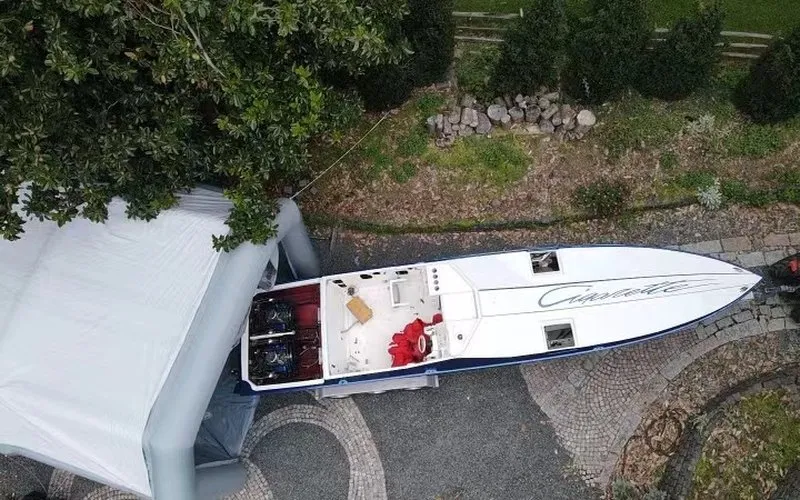
Outdoor yard pad · high-requirement marine finish
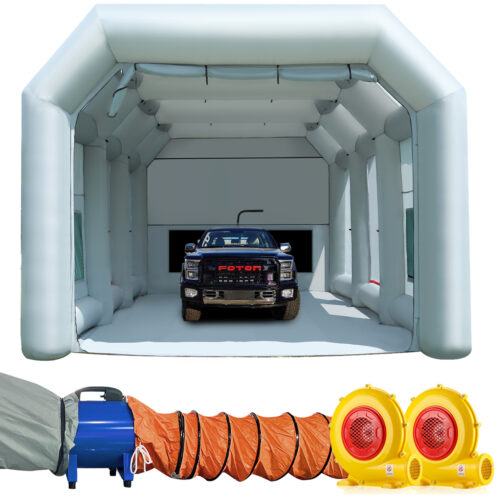
39 × 20 × 13 ft · repeatable build · branded
From project brief to an engineering answer.
No instant quote. No generic PDF. A structured review by the team that will build the booth.
Submit the brief
Use the four-step form below. Approximate answers are fine; “not sure” is a valid answer. 8–12 minutes.
Feasibility review
We assess whether inflatable technology fits the application, site, airflow and compliance constraints. If it does not, we say so.
Concept, budget, lead time
You receive a concept direction, recommended size, airflow approach, material/filtration recommendation, indicative budget and lead time.
Engineering & build
If the project proceeds, detailed drawings, calculations and production follow. Paid engineering is scoped and quoted separately after the free review.
Custom Project Feasibility Review
Tell us what the booth has to do. The questions below are the same ones our engineers ask on a first call. About 8–12 minutes; if you do not know an answer, choose “Not sure — advise me”. If you do not have drawings yet, that is normal — the review is designed to start before they exist.
Request received.
Your project brief reached our engineering team. We acknowledge within one business day, confirm what is missing, and give you a review date. If you have site photos or drawings, reply to our acknowledgement email.
Reference:
For anything urgent, call +1 626-586-3210 or WhatsApp the same number. We will tell you if inflatable is not the right fit — that is part of the review.
The rules a custom booth has to satisfy
A custom booth changes the dimensions, not the requirements. Airflow, enclosure and filtration are set by published US federal rules whatever the aircraft, bus or truck the shell is built around — which is why a custom build is specified against airflow and clearance first, and floor area second. If you finish flat panels, doors or furniture, see sizing a spray booth for a cabinet & furniture shop.
- OSHA 29 CFR 1910.107(b)(5)(i) — the airflow floor. Air velocity over the open face of the booth, or across the booth cross-section during spraying, must average not less than 100 linear feet per minute (60 ft/min for electrostatic spraying), and the booth must carry a visible gauge, an audible alarm or a pressure-activated device to show it is being held. It is a cross-section average, not a reading taken at the workpiece.
- 40 CFR 63.11173(e)(2) — the 98% filter requirement. Booth filters used for the target coatings must demonstrate at least 98% paint-overspray capture, by a procedure consistent with ANSI/ASHRAE 52.2-2017, and a booth used to refinish entire vehicles must be fully enclosed and operated under negative pressure. This is what a filter specification has to be written against.
- 40 CFR Part 63 Subpart HHHHHH — who it applies to. The rule covers area-source shops that refinish motor vehicles and mobile equipment. Surface coating performed by an individual on a personal vehicle or property, as a hobby or for maintenance, is exempt — a distinction worth knowing before you buy either way.
- OSHA 29 CFR 1910.106(d)(3)(i) — what a shop may store. A flammable-liquid storage cabinet is capped at 60 gallons of Category 1–3 liquids (120 gallons for Category 4), with a 30-day exemption for painting and maintenance quantities. This sets how much coating a shop may hold, not how large the booth is.
- OSHA 1910.107(b)(8) and (b)(9) — clearance. Three feet of separation from other operations, and three feet of clear space around the booth, are written into the standard. On a site that measurement, not the vehicle, is usually what decides the footprint.
- NIOSH isocyanate guidance — the painter. Two-part clears and polyurethane coatings are treated as respiratory sensitisers. Supplied-air protection is expected for spraying; the enclosure reduces exposure but is not a substitute for respiratory protection.
Sources checked 29 September 2026: OSHA 29 CFR 1910.107; OSHA 29 CFR 1910.106; eCFR 40 CFR 63.11173; eCFR 40 CFR Part 63 Subpart HHHHHH; EPA 6H surface coating rule page; ANSI/ASHRAE 52.2 filter-test procedure; NIOSH isocyanate guidance at cdc.gov/niosh.
Engineering depth, not a catalogue.
Every custom booth is specified by the same engineering team that builds it, in our own factories in Guangzhou and Vietnam, with US stock and support through EJAEE INC in California.
Want the reasoning behind these claims? Read Why Buy From Sewinfla — the engineering, the documented project results, and the plain statement of what we do and do not claim.
See the independent coverage and verified owner reviews: Sewinfla Reviews & Press — named publications, marketplace ratings with review counts, and the problems owners report.