Case Study · Custom Engineering
Pressure Vessel Coating: 90-Foot Modular Dual-Chamber Inflatable Booth
A returning customer came back with a far harder requirement: full-size pressure vessels that had to be coated inside a clean, contained environment — and moved in by rail. California, USA.
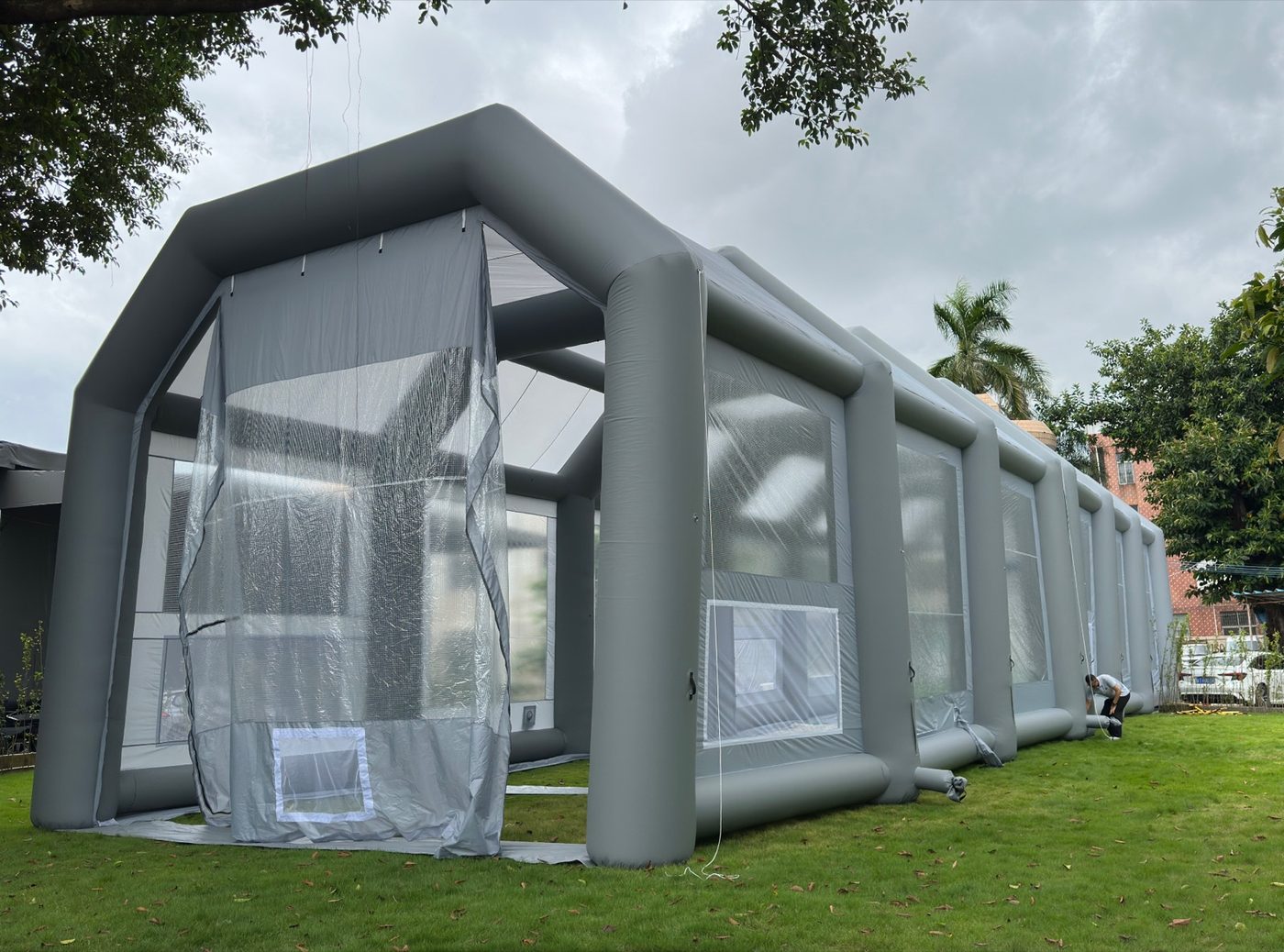
Client profile
| Industry | Pressure vessel manufacturing |
| Location | California, USA |
| Client type | Returning customer — previously bought a smaller Sewinfla booth |
| Application | Industrial spray coating of full-size pressure vessels |
The challenge — two constraints that ruled out any off-the-shelf booth
1. Extreme span
The booth had to reach 90 feet in length to enclose the vessel and the full coating workspace. A single inflatable chamber of that length sags and collapses at the midpoint under its own structural load.
2. Rail-cart access
The vessels could not be lifted or manually positioned. They had to roll into the booth on a rail-mounted cart — which meant a conventional built-in floor would obstruct the track.
The constraint. A standard long single-chamber booth fails structurally at the midpoint, and a standard built-in floor blocks the rail track the client already uses to move vessels. Both problems had to be solved in the same build, without asking the client to change their handling process.
Our custom solution
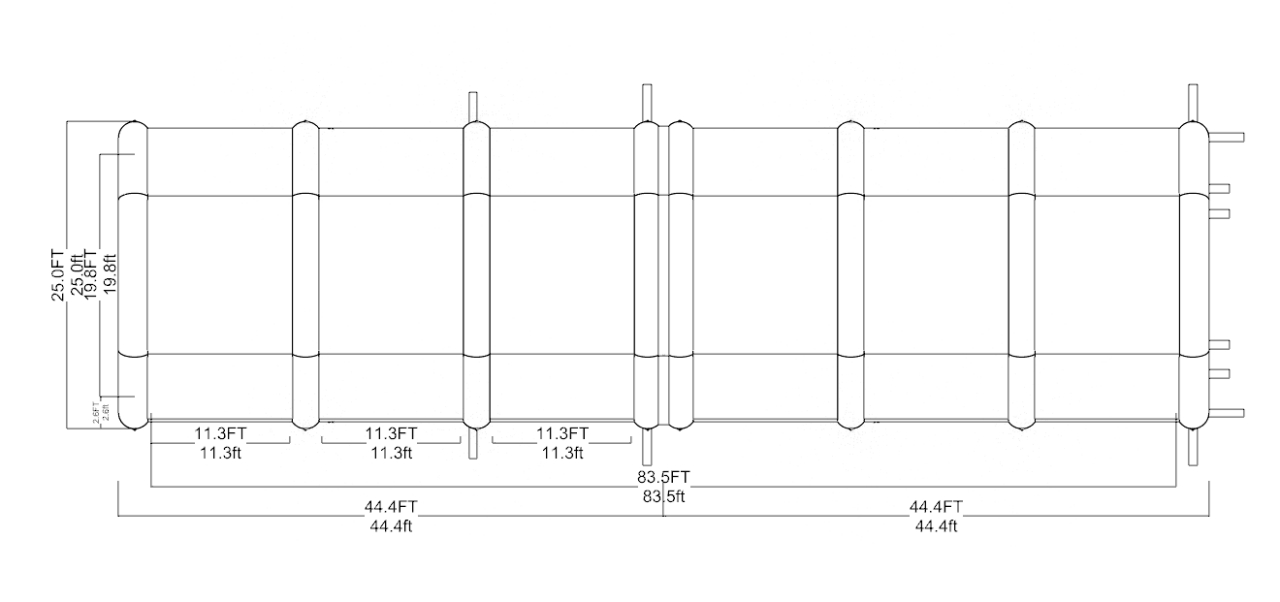
A purpose-built 90 × 25 × 20 ft (27.4 × 7.6 × 6.1 m) inflatable spray booth with two defining design decisions.
Design 1 — Modular dual-chamber construction (2 × 45 ft sections)
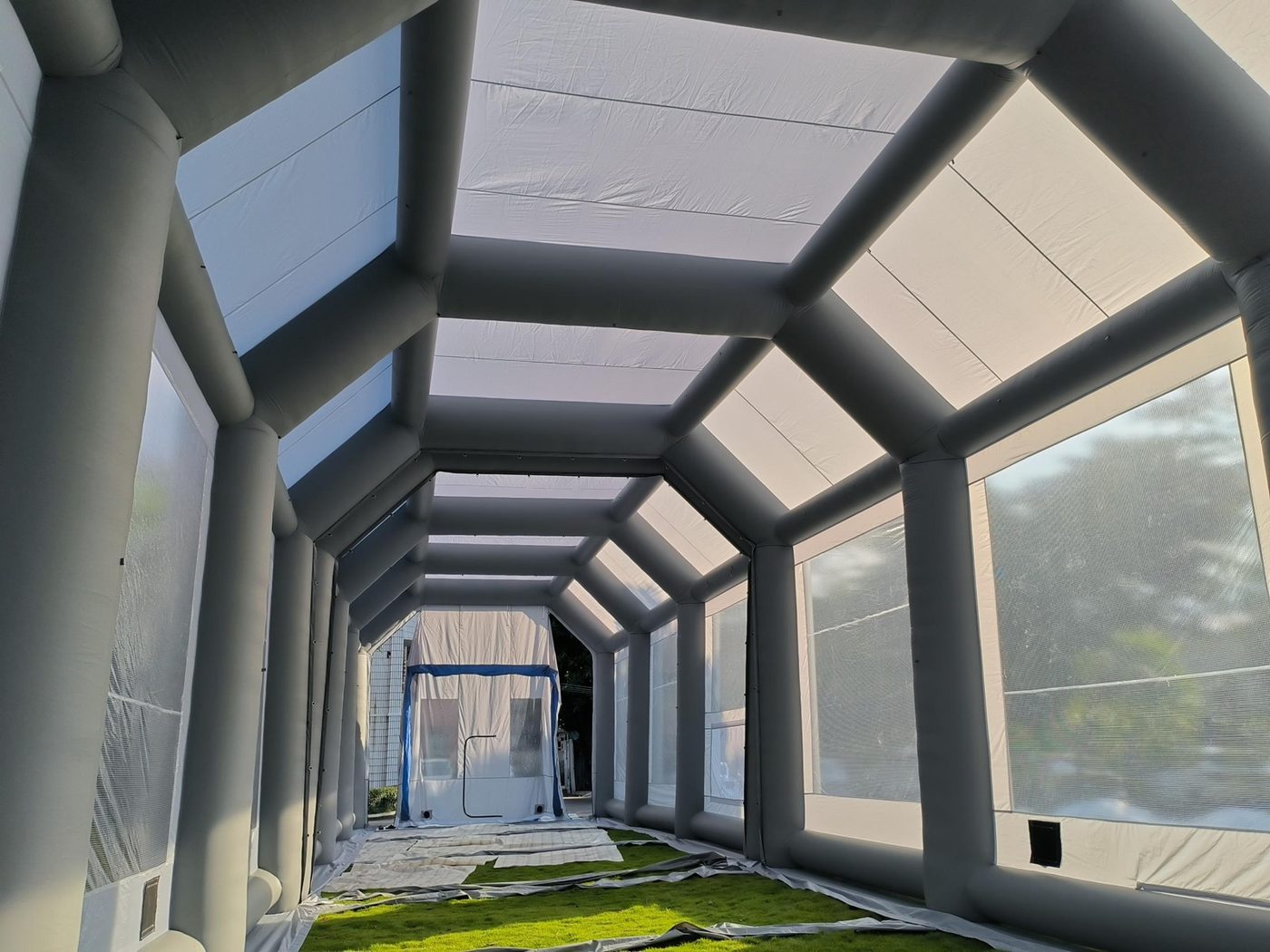
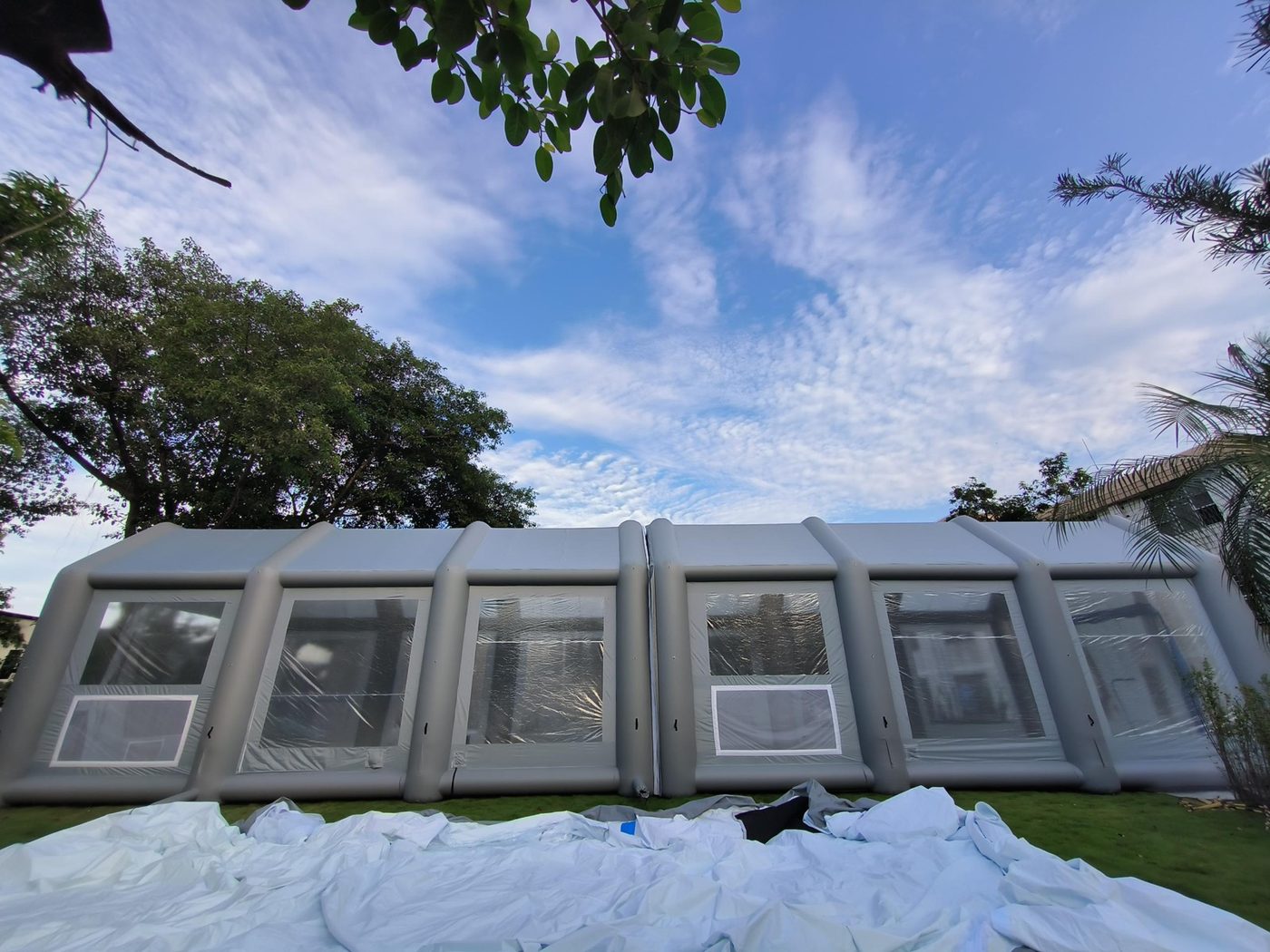
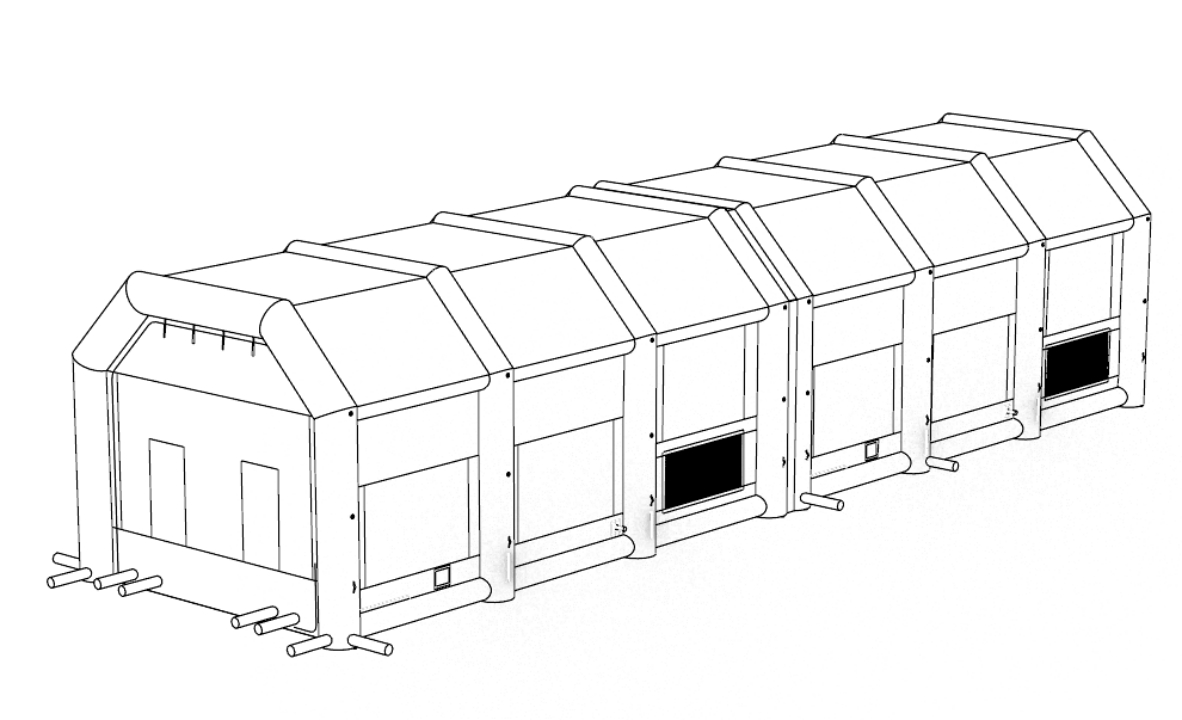
Rather than a single 90-foot chamber, the booth is built as two independent 45 × 25 × 20 ft sections joined together. Each section is a complete, self-supporting structure with its own air columns and load-bearing frame.
- No single unsupported span across the full 90 feet.
- Each section carries its own structural load, keeping the ceiling taut and fully supported end to end.
- The joined seam becomes a natural structural node — reinforcing the exact midpoint where a single long chamber would be weakest.
Design 2 — Removable Velcro bottom
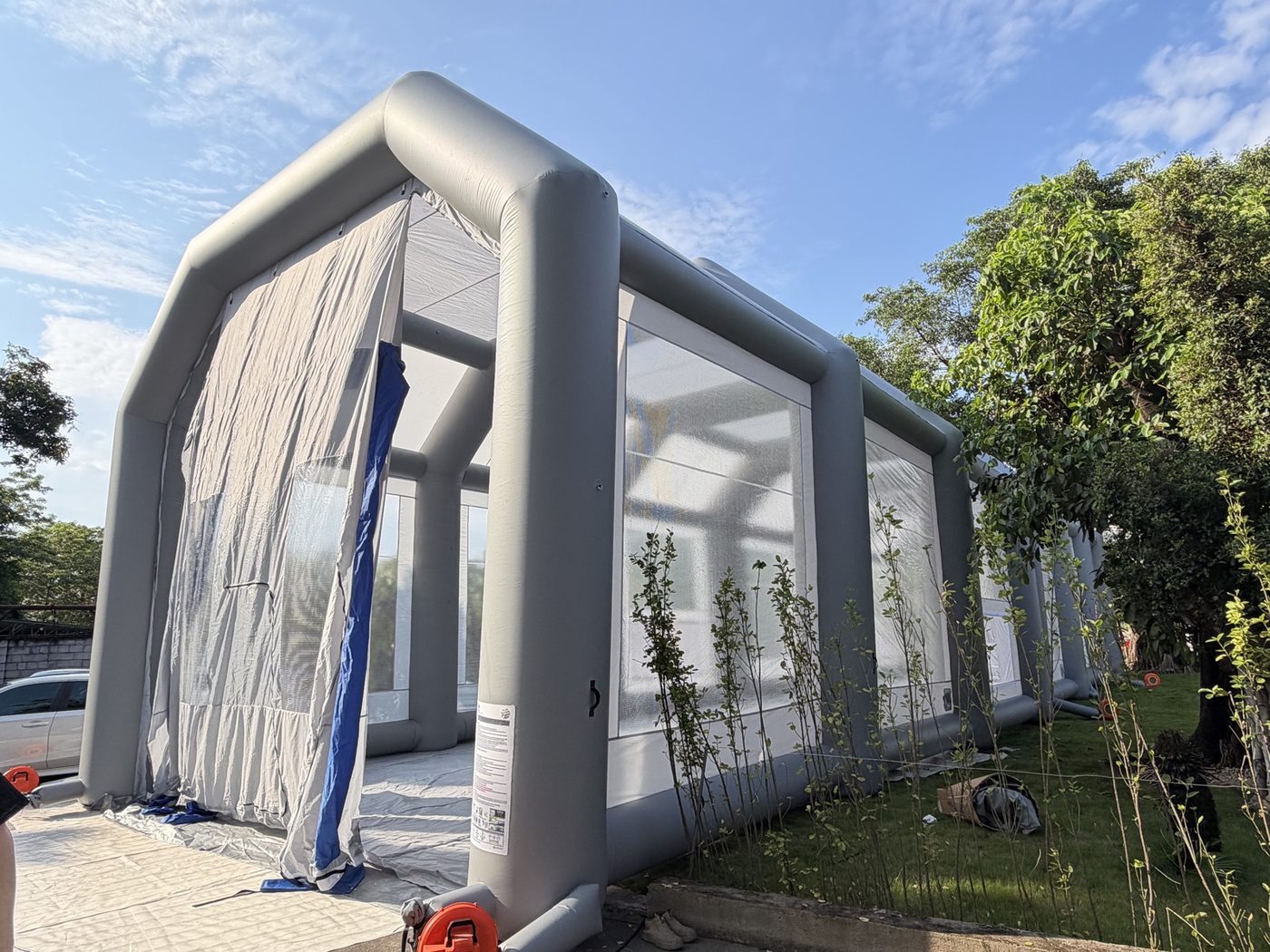
The standard built-in floor is replaced with a removable Velcro-attached bottom, engineered specifically for the client’s rail system.
- The rail track runs uninterrupted through the booth, so vessels roll in and out on the cart with no lifting and no obstruction.
- The bottom seals closed for overspray and dust containment during coating, and opens for track access and cleaning.
- Velcro attachment keeps the booth adaptable — sealed when coating, open for rail movement — without sacrificing containment.
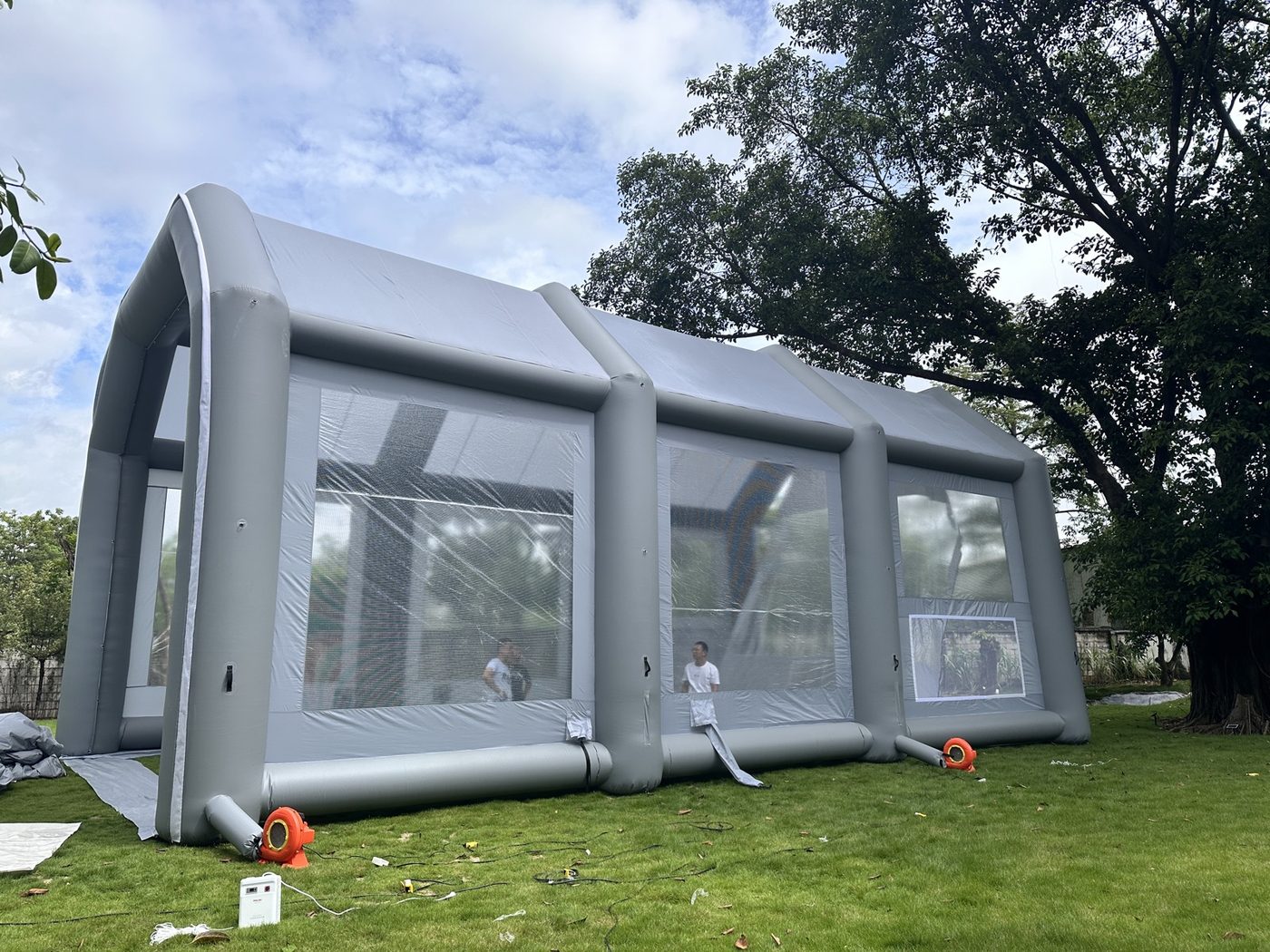
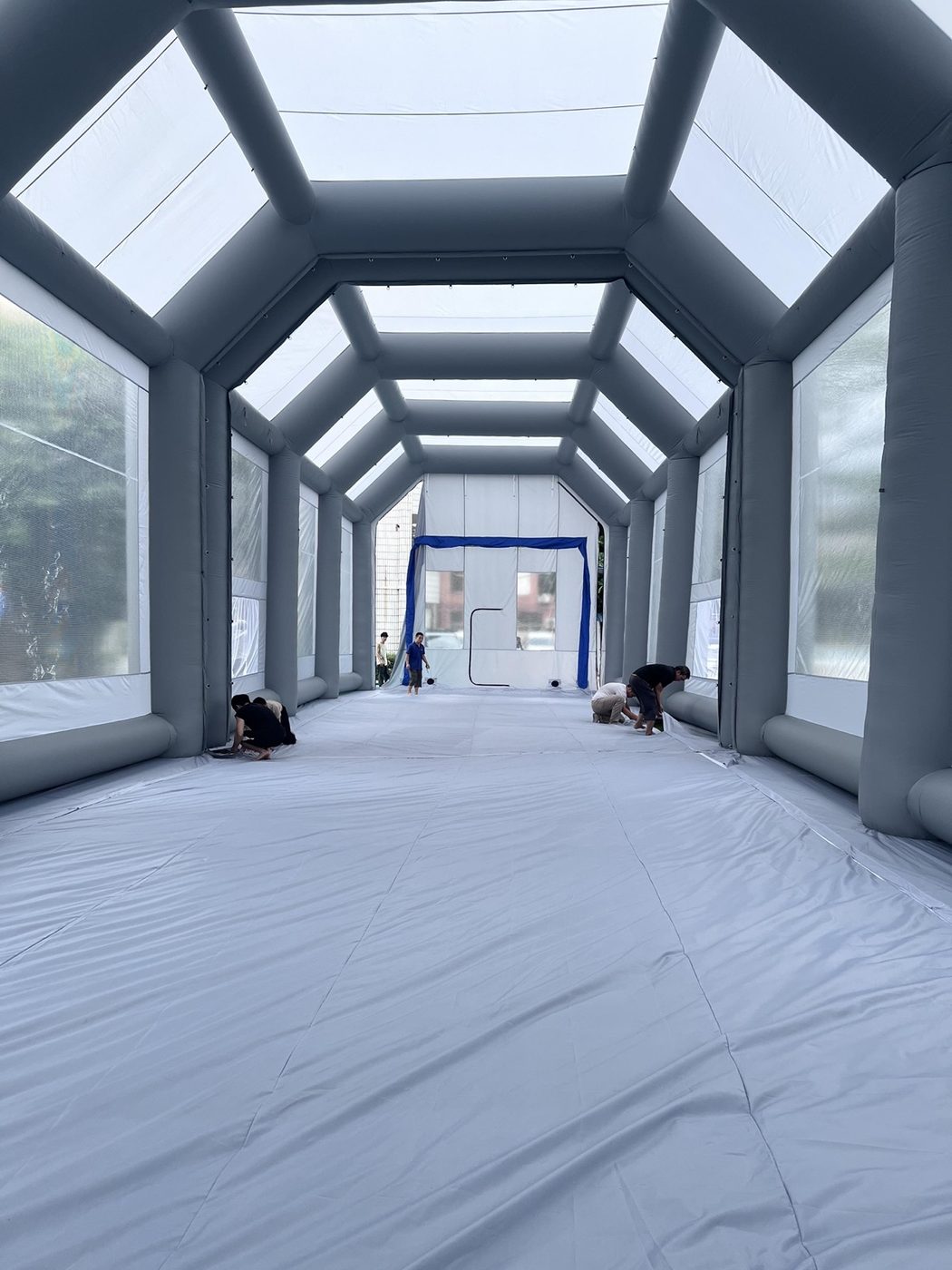
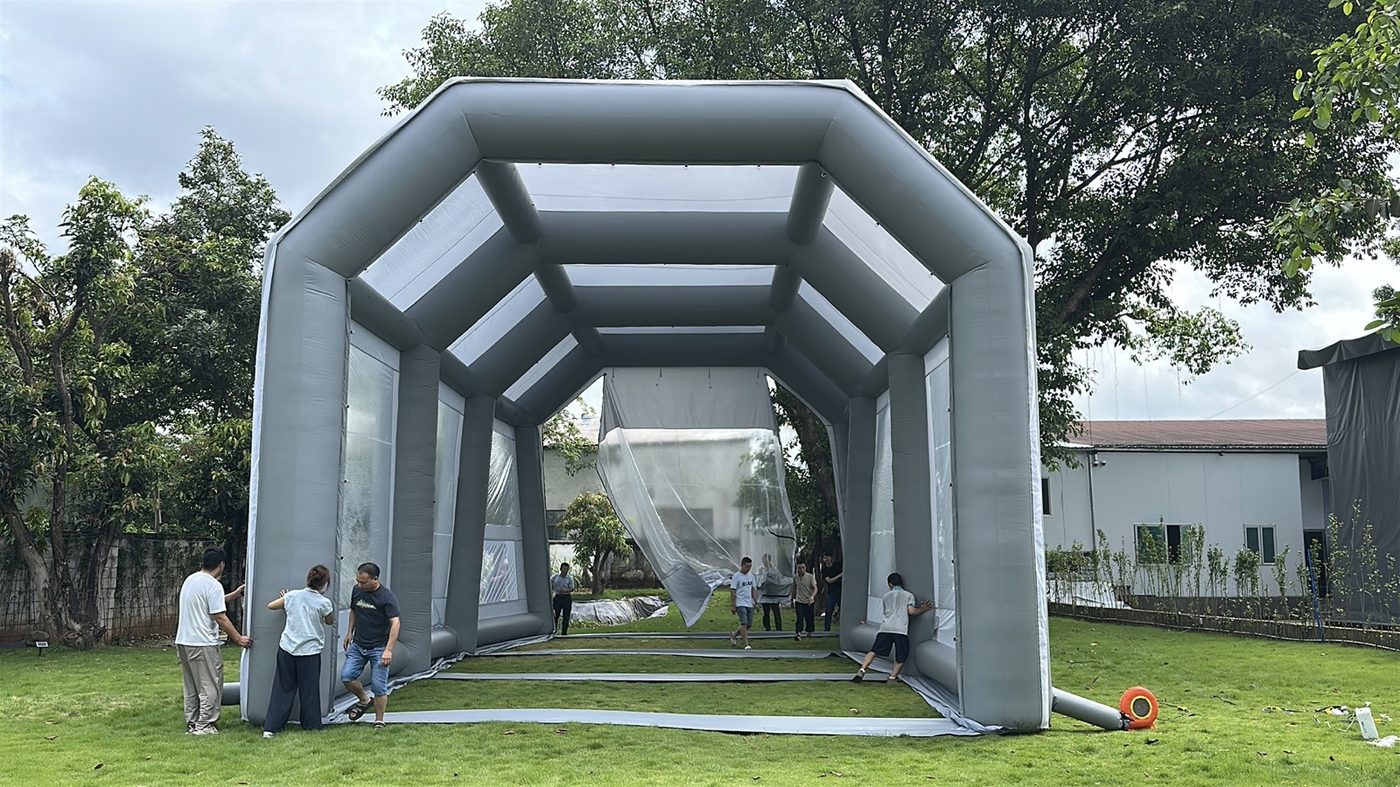
Factory testing photographs
Taken during factory testing, when the completed booth was erected and inspected before crating. They document the structure as built — not the client’s operating site.
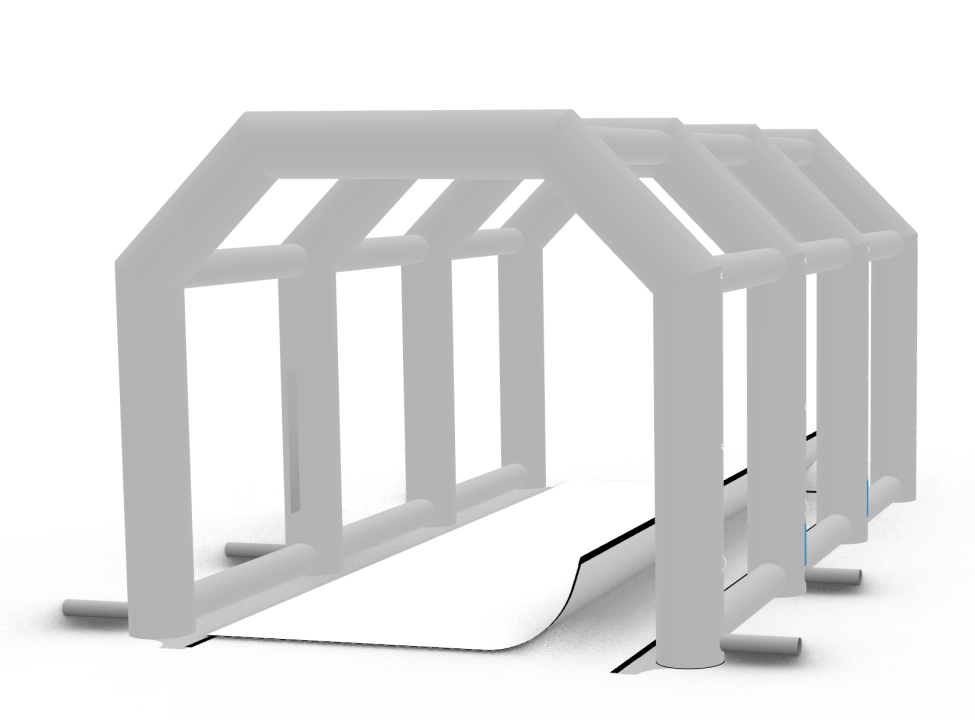
Design models
Production engineering models of this build — not photographs of the installed booth.
Specifications
| Overall dimensions | 90 × 25 × 20 ft (27.4 × 7.6 × 6.1 m) |
| Construction | Two 45 × 25 × 20 ft modular chambers, joined |
| Floor | Removable Velcro-attached bottom |
| Vessel access | Rail-mounted cart (track-compatible) |
| Application | Large pressure vessel spray coating |
Approximate. Handmade inflatable product, vary with air pressure/standing conditions. Product received prevails.
Why this approach
- Structural integrity at scale. Long single-chamber inflatables fail at the midpoint because one air column cannot hold tension across 90 feet. Splitting the span into two independent chambers turns a structural weakness into a support point.
- Workflow-first engineering. Instead of asking the client to change their process, we adapted the booth to their existing rail-cart material-handling system.
- Modular investment protection. The two-section design can be reconfigured, relocated, or individually replaced — protecting the client’s long-term investment.
Results
The figures below are the client’s own operating estimates, reported to us. They describe this client’s workflow and are not a performance guarantee for other applications.
- Cycle time. On-site coating removes transport and lifting of large vessels, cutting total cycle time by approximately 35% (client estimate).
- Cost. Roughly one-quarter the cost of a permanent steel-and-concrete booth — about 75% lower upfront, with no permits or long-term maintenance (client estimate).
- Containment. A fully sealed enclosure with the removable floor keeps overspray and dust contained for clean coating.
- Flexibility. The modular two-section structure dismantles, stores and relocates, freeing floor space when idle.
What made this build different. The problem was not “make a bigger booth” — it was two structural decisions taken together: split the span so no single chamber carries 90 feet, and remove the floor so the client’s existing rail system keeps working. Both served the same goal: adapt the booth to the workflow, not the workflow to the booth.
What this case does not claim
Stated plainly. The client is not named; they are described by industry only. The cycle-time and cost figures are the client’s own operating estimates, not audited measurements, and are specific to this workflow. This is a custom-engineering build rather than a catalogue size — if your vessel geometry and access method differ, the design will differ with them.
What This Build Is Checked Against
A 90 ft pressure-vessel booth is a workplace before it is a product, and the rules it answers to are federal spray-finishing rules, not a supplier’s specification. Two claims on this page — a contained coating enclosure, and a rail track running through the working area — are each read below against the clause that governs them. Where a clause assumes something this build is not, we say so rather than paraphrase it into agreement.
- OSHA 29 CFR 1910.107(b)(5)(i) — the airflow floor, and why no CFM figure appears on this page. “The average air velocity over the open face of the booth (or booth cross section during spraying operations) shall be not less than 100 linear feet per minute.” It is an average across the cross-section, and this enclosure measures 25 × 20 = 500 sq ft on that section. Airflow and the area it crosses are therefore one calculation (velocity = CFM ÷ face area), so we publish neither figure on its own: the extraction circuit for a vessel-coating duty is specified per project, and when the number is published it will carry the area with it.
- OSHA 1910.107(b)(1) — construction, as written, and airflow direction. Booths must be “substantially constructed of steel… or of concrete or masonry except that aluminum or other substantial noncombustible material may be used for intermittent or low volume spraying”, and must be “designed to sweep air currents toward the exhaust outlet”. Read plainly, a fabric enclosure is not what that construction sentence describes — so that half of (b)(1) is a question for the operator’s fire authority and insurer, not a claim a booth supplier can make on their behalf, and our Trust page states it the same way. The direction half is a design requirement this build does answer: sweeping toward the exhaust outlet is what keeps solvent vapour moving past the vessel instead of pooling around it. Because the envelope is a textile, the applicable flammability test method is NFPA 701, “Standard Methods of Fire Tests for Flame Propagation of Textiles and Films” — cited by designation, since its text sits behind a login and we do not quote figures from a standard we have not read.
- OSHA 1910.107(c)(9)(i) — grounding, which this build makes specific. “All metal parts of spray booths, exhaust ducts, and piping systems…shall be properly electrically grounded in an effective and permanent manner.” A rail-mounted cart means steel track and a steel carriage travel inside the spraying area. Bonding that rail run back to the building’s earth point is part of the installation rather than an accessory, and it is one reason the rail interface was fixed before production instead of on delivery day.
- OSHA 1910.107(b)(8), (b)(9) and (c)(2) — what has to sit around an enclosure this size. Each booth must be separated from other operations by not less than 3 ft or by a partition; a clear space of not less than 3 ft on all sides must be kept free of storage and combustible construction; and no open flame or spark-producing equipment may be in a spraying area, or within 20 ft of it, unless separated by a partition. A 90 ft chamber occupies a large share of a bay, which is why the surrounding layout was settled ahead of the build rather than around it afterwards.
- 40 CFR § 63.11173(e)(2)(i) — what the containment claim is actually measured by. Booth filters must demonstrate “at least 98 percent capture of paint overspray”, by a procedure “consistent with the ANSI/ASHRAE Standard 52.2-2017”. Containment is a filter-performance claim, not a fabric property: the removable floor described above is a containment measure, while the filter bank is the part the clause tests. Whether the rule reaches a given vessel-coating operation is a determination for the operator’s state or local air-quality agency.
- OSHA 1910.107(b)(5)(ii) and 1910.106(d)(3)(i) — consumables and stored solvent. Discarded filter pads and rolls must be “immediately removed to a safe, well-detached location” or held in a water-filled metal container and disposed of at the close of the day’s operation; and a storage cabinet may hold not more than 60 gallons of Category 1, 2 or 3 flammable liquids — 120 gallons of Category 4. An industrial coating job consumes filters and solvent at a rate a hobby booth never does, and both rules are housekeeping obligations that scale with the job.
Sources checked 1 October 2026: OSHA 29 CFR 1910.107 (construction, airflow direction, grounding, clearance, filter-media disposal); OSHA 29 CFR 1910.106 (flammable-liquid storage); Cornell LII 40 CFR § 63.11173 (98 percent overspray capture, ANSI/ASHRAE 52.2-2017 procedure); NFPA 701 (flame propagation, textiles and films — cited by designation).
Need a booth engineered around your workflow?
Send us your dimensions, your access method and your coating requirements — we will design a custom solution built for your exact process.